
Unlock Your Pleasure with a Yes/No/Maybe List
Let's be honest: for many, the "safer sex" conversation can feel like a clinical checklist. "Are you clean?" "When were you last tested?" It’s crucial, but it sometimes seems more like a bureaucratic hurdle than an intimate connection. Couple that with the hustle of daily life, our own desires are often the first thing to get quiet. Too often, we end up in sexual situations not speaking our minds, not knowing what our partners want but hesitating to ask, and thinking, "I guess this is okay?" instead of, "Yes, this is exactly what I want!" Using a Yes/No/Maybe list not only helps you have safer sex conversations but they ground them in our embodied desires, allowing you and your partners to connect more authentically while touching on important topics.
What Exactly is a Yes/No/Maybe List?
To keep it simple, a Yes/No/Maybe list is a comprehensive checklist of sexual activities, desires, and boundaries where you and your partners individually mark each item as:
Yes: Things I'm excited to try and enthusiastically consent to.
No: Things I'm not interested in and do not consent to. (Hard limits).
Maybe: Things I'm curious about but have questions about, or would need specific conditions to try.
The magic isn't just in checking boxes; it's in the conversation that happens after you compare your lists. Let’s dive in further.
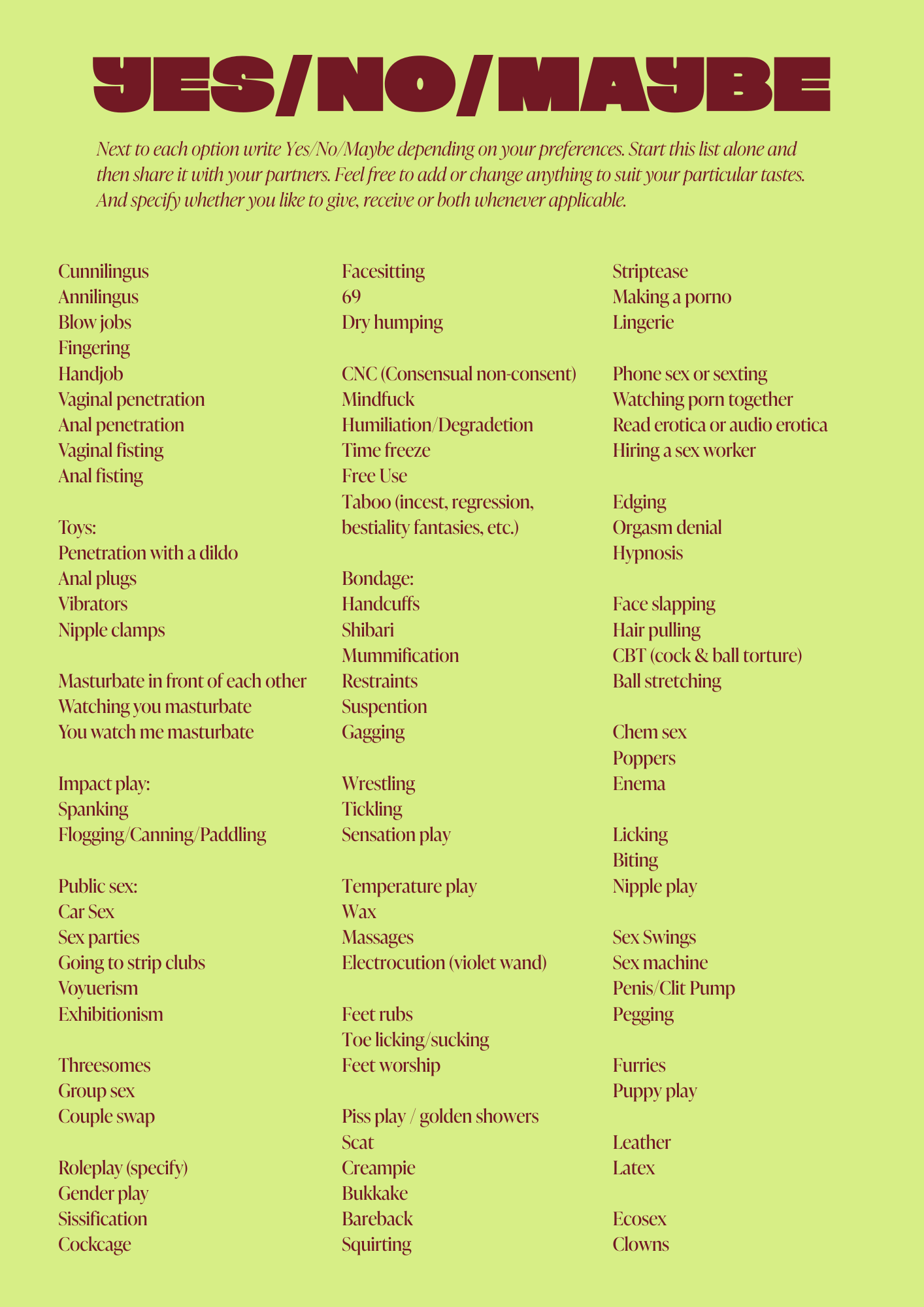
A Date with Yourself
The best way to approach a Yes/No/Maybe list is to start alone. Before anyone else sees your list, fill it out independently. This private act should be viewed as a quest to know yourself better. Alone, with no pressure to perform or please, you ask yourself the most important question: "What do I actually want?"
This isn't about what you think you should want, or what your past or current partners like, or what you see in porn or media. This is about your authentic, unique desires. The list provides the structure and vocabulary to explore corners of your sexuality you may have never given yourself permission to consider.
Note: for many people, admitting their desires (especially ones they’ve repressed or that are socially taboo) even to themselves can feel really scary. It’s okay if you’re not ready to share everything that you put on your Yes/No/Maybe list with your partners. You can always make an abbreviated version of things you want to share, omitting items that feel too difficult or unsure to talk about if you need more time to process. This is where the Maybe category can also come into play, we’ll get to that in a second. But during this initial part we want you to be honest with yourself, without worrying about having to share everything with other people. Some things take time and we get that! The goal of a Yes/No/Maybe list isn’t to force you to out yourself before you’re ready, it’s meant to empower you in the bedroom.
Three Categories Reveal Desires and Limits
The simple genius of "Yes," "No," and "Maybe" creates a nuanced framework for understanding your inner world.
The "Yes" List: Your Pleasure Map
Filling out the "Yes" column is an act of claiming your desires. It’s a concrete list of what makes you feel good, what you’re confident about, and what truly turns you on. Seeing your "Yeses" written down is empowering. It transforms vague ideas into a defined menu of your pleasure. Use this section as your foundation of confidence and self-assurance.
The "No" List: The Art of Honoring Your Boundaries
Equally important is defining your "Nos." This doesn't have to be viewed as a list of negatives; it can rather be a positive affirmation of your comfort and safety. Clearly identifying your boundaries is an act of self-respect. It allows you to enter situations with clarity and confidence, knowing you've already decided where your lines are. And it helps other people see your limits so they are better equipped to honor them. This preemptive work makes it easier to communicate with partners. It also helps you recognize people who repeatedly push or violate those boundaries so you can remove yourself from those situations or relationships when necessary.
The "Maybe" List: The Playground of Curiosity
This is where the real discovery happens. The "Maybe" column is a space for curiosity without commitment. It’s for the things that pique your interest but come with questions:
"Maybe I'd like being blindfolded... if I fully trusted the person."
“I know you have this specific kink, maybe I could explore it with you”
"Maybe I'd try that... but I'd need to know more about how it works."
"That sounds intriguing in theory, but I'm not sure how it feels in practice."
Your "Maybes" are the growing edges of your sexuality. They represent potential, curiosity, and a willingness to learn more about yourself. They are invitations for further research, self-reflection, or conversation. There’s no pressure to act on the maybe list, some items may remain there forever, relegated to the safety of pleasurable fantasy. But it also illustrates areas to explore, especially if you and your partners enter a period of sexual stagnation and want to explore new realms together.
Building Confidence
When you truly know what you want, what you don’t, and what you’re curious about, your entire approach to intimacy shifts. You move from a passive participant to an engaged lover. You no longer have to scramble to answer when a partner asks, "What are you into?" You can say with clarity, "I'm really into this, I'm not into that, and I've always been curious about trying this other thing.” This self-knowledge is the deepest form of safer sex. It creates emotional safety within yourself, which is the prerequisite for creating physical and emotional safety with partners. It ensures you are engaging not out of obligation, but out of genuine desire.
Talking To Your Partners
Depending on your history and cultural background, talking about sex can feel daunting or downright shameful. While we can all strive to be more direct and communicative in the bedroom, it’s normal if you and your partners still have some hangups when it comes to discussing sex. But having a Yes/No/Maybe list can facilitate these conversations by giving you a template to structure your conversations. Now, obviously, simply having this tool doesn’t alleviate all potential issues, you will still need to grapple with several questions.
“What if there are things I’m embarrassed to share with my partner?”
“What if my partner is into some really weird stuff that I’m not into?”
“What if we realize that our desires aren’t sexually compatible?”
While these fears are valid, it’s important to remember that a Yes/No/Maybe list isn’t a legally binding document, it’s simply an invitation to share your desires and limits with your partners. Once you’ve compared lists, you are free to decide how you will implement the respective items into your sex life. Just because an item appears on one of your Yes lists doesn’t mean you’re obligated to incorporate it into the sexual relationship. Part of being an adult is recognizing that one partner will not meet 100% of your needs. There’s a good chance that parts of your respective lists will remain individual; this is why having a healthy relationship to masturbation and fantasy can be important.
As we touched on above, the goal for these conversations isn’t to spiral you into shame or force you to reveal information that you’re not ready to talk about. It’s important to leave your judgment at the door before you enter the conversation with your partner. If there are things on their lists that you don’t like, that’s okay. But please be mindful that sharing desires and limits can feel vulnerable, so treat your partner’s disclosure with respect. Similarly, be prepared for your partner to not be enthusiastic about every single item on your Yes list. Avoid viewing differences in preferences as rejection. It’s normal to not share everything. Instead focus on what you each have in common and be sure to spend time discussing some potentially exciting new exploration from your respective maybe lists.
Exploring Safely Together
Once you and your partner have shared your individual lists, you can consider making a joint Yes/No/Maybe list. This helps to reiterate what you will and won’t include as part of your sex life. Certain items that were on your respective Yes lists, but aren’t shared, may need to be reclassified into your joint Maybe list. Being able to create this new list doesn’t negate your individual ones, but it does help to create a roadmap for your sexual relationship together.
When it’s time to explore items on your joint Maybe list, it’s important to have safe words (or to use the stoplight system - green means your good, yellow means you need to slow down, red means you need to stop). Exploring new sexual activities can sometimes be risky, and knowing that you can easily communicate to your partner to stop if things are taking a turn is vital for building safety. And remember, that some sexual practices take time to learn. For example, you may both be interested in exploring Shibari, but your first try will most likely be awkward as you need to develop a substantial amount of skills. Give each other time to acclimate to new sexual activities.
Remember the Yes/No/Maybe list is a living document. Return to it often, reevaluate whether certain items need to be added, removed, or reclassified. Our sexual preferences evolve as we age so it’s important to not feel stuck or bond by an outdated list.
Happy exploring!